Face Mesh Detector
Finds faces and returns 478 landmarks for each, covering the face outline, eyes, eyebrows, lips and irises.
Basic use
import cv2 as cv
from detectors_world import create_detector

cap = cv.VideoCapture(0)

with create_detector("face_mesh", max_faces=1) as face_mesh:
    while True:
        ok, frame = cap.read()
        if not ok:
            break

        faces = face_mesh.detect(frame)
        if faces:
            print("Nose tip:", faces[0][1])

        cv.imshow("Face Mesh", frame)
        if cv.waitKey(1) & 0xFF == ord("q"):
            break

cap.release()
cv.destroyAllWindows()
Options
| Option | Default | Meaning |
|---|---|---|
max_faces |
2 |
Largest number of faces to look for |
detection_confidence |
0.5 |
Minimum confidence to report a new face |
tracking_confidence |
0.5 |
Minimum confidence to keep following a face between frames |
static_image |
False |
Set to True for unrelated photos |
model_path |
None |
Use your own copy of face_landmarker.task |
Landmark map
This map labels the landmarks you are most likely to need, and colors each region. "Left" and "right" are the person's own sides.
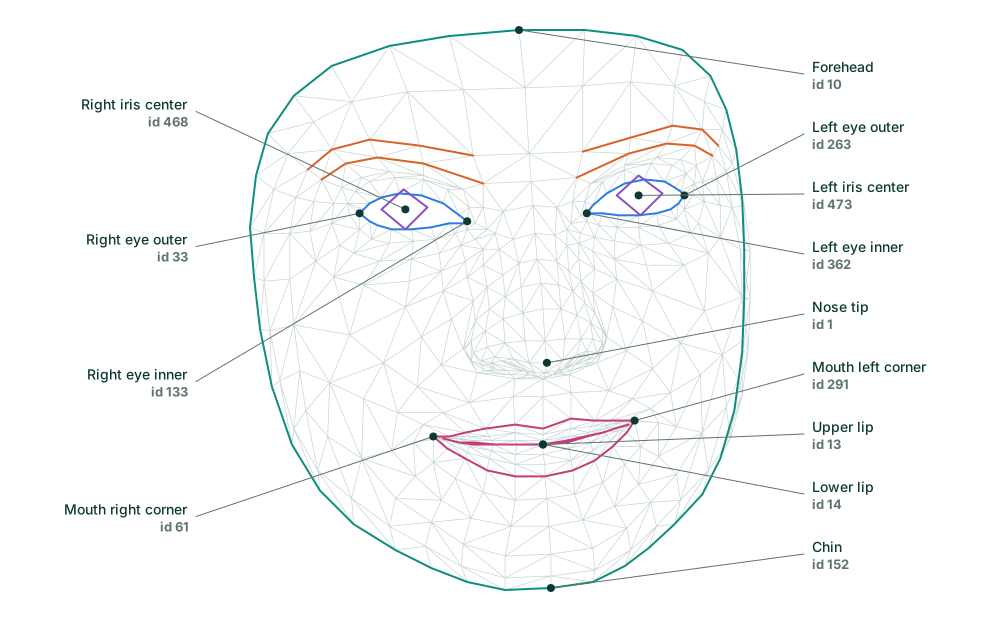
| Id | Landmark |
|---|---|
| 1 | Nose tip |
| 10 | Top of the forehead |
| 152 | Chin |
| 33, 133 | Right eye outer and inner corners |
| 362, 263 | Left eye inner and outer corners |
| 159, 145 | Right eye upper and lower lids |
| 386, 374 | Left eye upper and lower lids |
| 468, 473 | Right and left iris centers |
| 61, 291 | Right and left mouth corners |
| 13, 14 | Upper and lower lip, inner edge |
Landmarks by region
| Region | Landmark ids |
|---|---|
| Face outline | 10, 21, 54, 58, 67, 93, 103, 109, 127, 132, 136, 148, 149, 150, 152, 162, 172, 176, 234, 251, 284, 288, 297, 323, 332, 338, 356, 361, 365, 377, 378, 379, 389, 397, 400, 454 |
| Lips | 0, 13, 14, 17, 37, 39, 40, 61, 78, 80, 81, 82, 84, 87, 88, 91, 95, 146, 178, 181, 185, 191, 267, 269, 270, 291, 308, 310, 311, 312, 314, 317, 318, 321, 324, 375, 402, 405, 409, 415 |
| Left eye | 249, 263, 362, 373, 374, 380, 381, 382, 384, 385, 386, 387, 388, 390, 398, 466 |
| Right eye | 7, 33, 133, 144, 145, 153, 154, 155, 157, 158, 159, 160, 161, 163, 173, 246 |
| Left eyebrow | 276, 282, 283, 285, 293, 295, 296, 300, 334, 336 |
| Right eyebrow | 46, 52, 53, 55, 63, 65, 66, 70, 105, 107 |
| Left iris | 474, 475, 476, 477 |
| Right iris | 469, 470, 471, 472 |
Find any landmark
To see every number on your own face, write the ids onto the frame:
faces = face_mesh.detect(frame, draw=False)
face_mesh.locate(frame, show_ids=True)
Make the window large, because 478 numbers fill a small image quickly.
Results
face_mesh.detect(frame) returns a list of Landmarks, one per face:
faces = face_mesh.detect(frame)

if faces:
    found = faces[0]
    found.points       # 478 (x, y) pixel positions
    found.normalized   # 478 (x, y, z) values
    found[1]           # the nose tip, as (x, y)
label and score are None for faces.
Drawing
detect() draws a ring on each landmark and the outlines of the face, eyes, eyebrows and lips:
| Argument | Default | Meaning |
|---|---|---|
draw |
True |
Draw the mesh |
color |
(224, 224, 224) |
Color as (blue, green, red) |
thickness |
1 |
Line thickness in pixels |
radius |
2 |
Ring radius in pixels |
Finding landmarks with locate()
face_mesh.locate() returns one face as [[id, x, y], ...]. Unlike the other detectors, it only draws when you ask, because 478 markers would cover the face.
face_mesh.detect(frame)
landmarks = face_mesh.locate(frame, face=0)
| Argument | Default | Meaning |
|---|---|---|
face |
0 |
Which face to return, counting from 0 |
draw |
False |
Draw a dot on each landmark |
show_ids |
False |
Write each landmark's number on the frame |
color |
(0, 255, 0) |
Dot and text color as (blue, green, red) |
radius |
1 |
Dot radius in pixels |
It returns [] if that face isn't visible.
Recipes
How open is the mouth?
Compare the gap between the lips with the width of the mouth, so that the result doesn't change with distance from the camera:
import math

gap = math.dist(found[13], found[14])
width = math.dist(found[61], found[291])
mouth_open = gap / width > 0.3
Is an eye closed?
height = math.dist(found[159], found[145])
width = math.dist(found[33], found[133])
right_eye_closed = height / width < 0.2
The Blink Counter builds on this.
Related
- Blink Counter
- Face, if you only need face boxes
FaceMeshin the API reference